
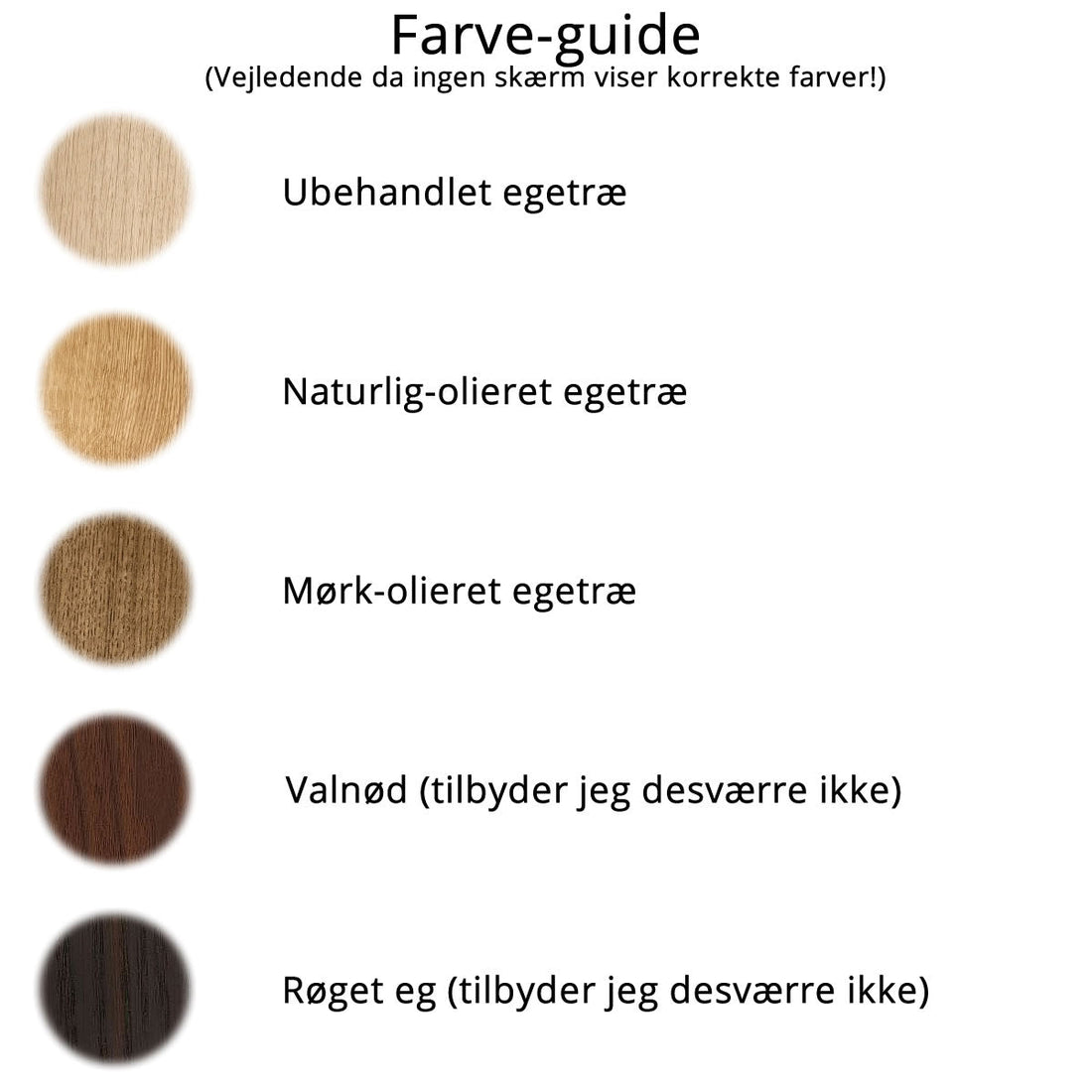
Guide: What colour should your wood products be?
Wood products are a popular choice for the home, as they combine functionality with a natural and light expression that suits many types of decor, as it doesn't become too heavy.
But what color and treatment should you choose for your wood products?
This guide reviews different types of treatments – from completely untreated wood to special treatments like smoked oak.
By choosing the right treatment, you can extend the durability and enhance the appearance of your products.
Here is a general overview - and further down I go into detail with selected variants.

1. Untreated wood (Raw but sanded)
Untreated wood offers a clean and natural look, where the wood's structure and grain truly come into their own. The wood is sanded for a smooth surface and a beautiful finish, but there are no additional treatments to protect it from moisture, dirt, or wear.

As a starting point, I only offer the Gatis hook in untreated wood (due to limited storage space), but all products we manufacture ourselves can be custom-made in untreated wood if desired. Contact me for more information.
Advantages:
- Preserves the natural appearance of the wood
- Ideal for those who want to add their own treatment
- Develops a patina over time
Disadvantages:
- Vulnerable to stains and moisture
- Requires regular maintenance to stay beautiful
- Develops a patina over time
2. Natural Oiling (transparent wax oil)
By applying a transparent wax oil, the wood's natural color and grain are preserved, while also providing a protective surface. This treatment gives a slight sheen and enhances the wood's natural beauty.

All products that I or my carpenter have designed and manufactured are available in this natural version.
Advantages:
- Protects against moisture and dirt
- Preserves the natural appearance
- Easy to maintain
Disadvantages:
- Has a more golden look than untreated wood
- Is darker than untreated wood and white-oiled wood
- Not suitable for self-treatment if a color change is desired
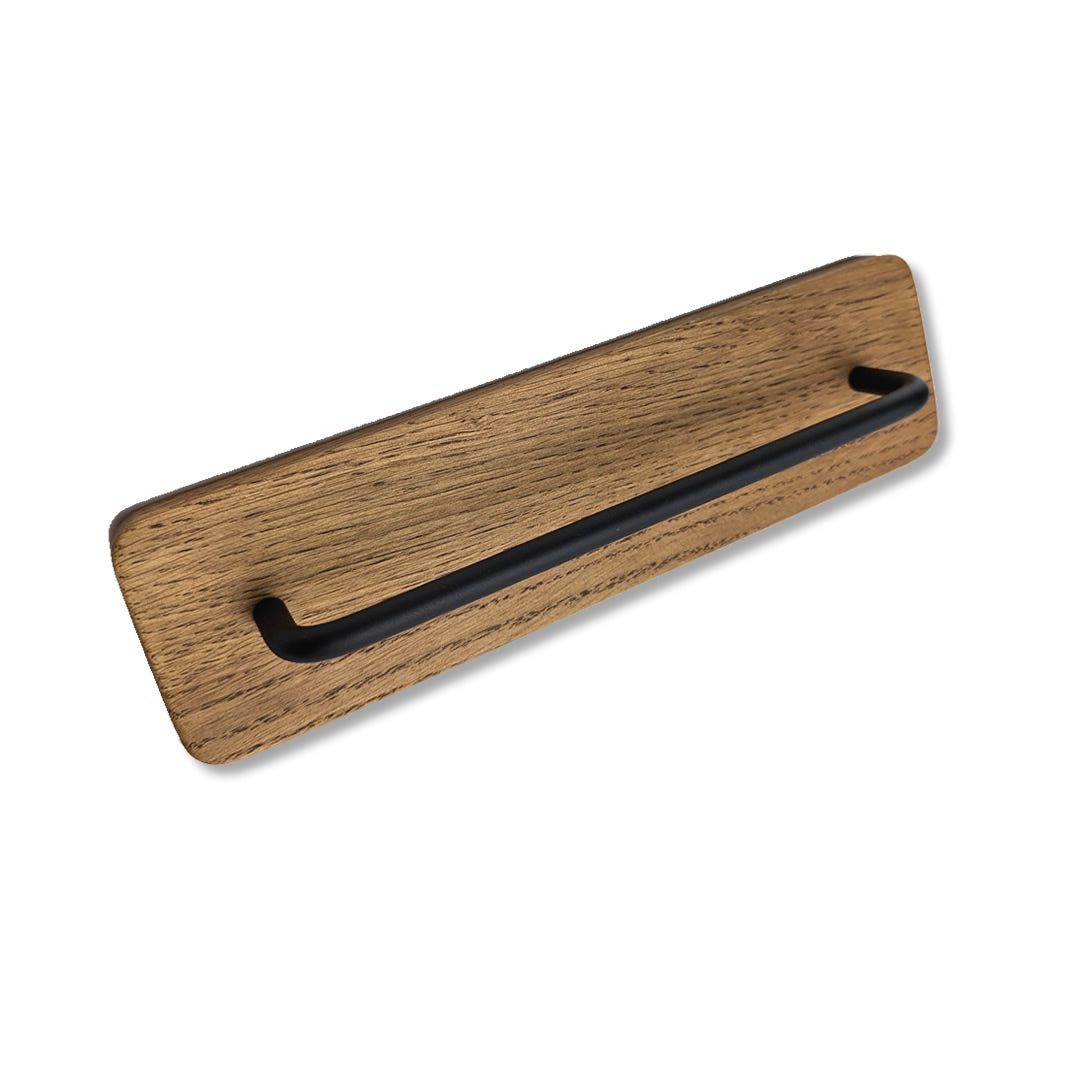
3. Brown Oiling (brown-pigmented wax oil)
Brown wax oil adds warmth and depth to the wood. This treatment contains pigments that give the shelves a beautiful brown color without concealing the grain. You thus still get that warm glow and can match other dark elements in your interior.
Many of the products that I or my carpenter have designed and manufactured are available in this brown version.
Advantages:
- Creates a warm and rustic look
- Protects against daily wear and tear
Disadvantages:
- The color is lighter than smoked oak
- Products with color pigment will always fade slightly over time
- Difficult to match the color 100% with other products in the interior (that are not from PureTime)
4. Dark Brown Oiling (dark brown-pigmented wax oil)
Dark brown wax oil provides an even deeper and more dramatic color than the brown treatment. This type of treatment is ideal if you want a sophisticated look, but it is important to note that dark brown is not the same as smoked oak.
As a rule, I do not offer products in the very dark brown variant, as experience shows it is very difficult to match existing decor in the home.
Advantages:
- Creates a deep, elegant color
- Effectively protects the wood
Disadvantages:
- May appear too dark in small rooms
- Requires regular maintenance to preserve the color
- It can resemble smoked oak, but smoked oak is usually darker
5. Smoked Oak (Special process and color type)
Smoked oak is not a treatment in the traditional sense, but rather a process where the wood is exposed to ammonia fumes. This gives the wood a dark, uniform color, reminiscent of a natural patina.
We do not work with smoked oak at all, as it is a very special process that requires something different and more compared to our traditional wax oils.
Advantages:
- Unique and exclusive color
- Preserves the wood's texture
Disadvantages:
- More expensive than other treatments
- Can be harder to combine with other colors
- Is harder on the environment in the treatment process
6. White Oiling (White-pigmented wax oil)
White-pigmented wax oil is perfect if you want a light and modern look. The white pigmentation brightens the wood, while the wax oil protects the surface.
We do not offer white oiling, as there are several variants of 'white' that can be used - and it is difficult to achieve the desired result in relation to existing decor.
Advantages:
- Creates a bright and light look
- Protects against stains and moisture
Disadvantages:
- Can be difficult to maintain in very dirty environments
- White is not just 'white' - but can be obtained in several shades.
7. Walnut (oiling or wood type)
Walnut is a whole wood species in itself, where the color typically has a slightly more reddish and dark, golden glow than the dark variant I use on my products.
Walnut is also available as a 'color', but we do not offer oiling in walnut color, as there are several variants of walnut color that can be used - and it is difficult to achieve the desired result in relation to existing decor.
Advantages:
- Matches other interiors in walnut wood or walnut color
- A very warm and golden wood type
Disadvantages:
- Can be difficult to match with other colors/products, unless opting for a light contrast
- Walnut wood is not found in Europe and must therefore be imported, which is not good for the environment
How do you choose the right color?
The choice of color depends on your style and practical needs.
If you love the natural look, untreated or transparent wax oil is a good choice.
For a more dramatic or exclusive look, the brown shades can be the perfect match. White treatment is ideal for the Danish design style.
